Occupational Therapy Utilizing Equine Movement (Hippotherapy)
What is Hippotherapy?
Hippotherapy is an evidence based treatment tool utilized by Occupational Therapists, Physical Therapists and Speech Language Pathologists. The therapist control and modify equine movement to engage sensory, motor and cognitive systems. Hippotherapy as a treatment tool should be utilized in combination with other treatment tools and strategies in the patient’s plan of care. Many systems are influenced with the use of equine movement as a treatment tool. Some of these systems include: motor, musculoskeletal, nervous/limbic, respiratory, circulatory, sensory processing, cognition, and speech and language
Why Horses?
The Rhythmic Nature of Equine Movement
The horse’s movement provides sensory motor experiences that are precise, rhythmic and repetitive. All of which are necessary for most human behavior
Dynamic Systems Theory
Equine movement impacts many different systems in the body. Any system can influence the other systems in the body. This impact on multiple systems promotes organization and improves the potential for learning.
Motor Learning Theory
The horse’s movement provides a repetitive, predictable, and symmetrical dynamic surface on which the patient can develop and practice functional postural control and balance. The horse averages 2500-3000 steps per 30 minute treatment resulting in approximately 100 inputs per minute. Sustained repetitive movement means more opportunity for practice.
Sensory Integration Frame of Reference
Horses provide the client with sensory rich experience. Therapists manipulate equine movement and pick a specific equine partner for a patient based on sensory properties such as the proprioceptive, vestibular and kinesthetic input that their movement provides. The sensory integration frame of reference examines the interaction between sensory systems and provides information that plays a large part in a child’s learning and behaviors. This frame of reference focuses on a child’s ability to make adaptive responses to constantly changing sensory environments. Working with the equine and in the outdoor environment allows us to target sensory integrative skills through use of connection with equine and the constantly changing outdoor environment. This includes targeting sensory modulation, sensory discrimination, postural-ocular control, praxis, bi-lateral integration and planning.
2026-2027 Schedule
Occupational therapy sessions utilizing equine movement are run in semesters which are groups of either 8 or 16 sessions. For new patients this includes a 1 hour video consultation prior to initial evaluation at the farm. For returning patients this includes a 1 hour video or clinic based progress consultation before each semester begins.
Fall Semester 2026 (16 weeks) August 30th- September 5th 2026 Intake/progress check-in week (virtual or clinic based) December 19th 2026 (equine sessions) Break week: November 22nd-28th Thanksgiving
Winter Semester 2027 (8 weeks) January 3rd-9th Intake/progress check-in week (virtual or clinic based) January 3rd- February 27th 2027 (equine sessions)
Spring Semester 2027 (16 weeks) February 28th-March 6th Intake/progress check week (virtual or clinic based) March 7th- June 19th 2026 (equine sessions)
Summer Semester 2027 (8 weeks) June 27th-July 3rd 2027 Intake/Progress check-in week (virtual or clinic based) July 4th-August 21st 2027 (equine sessions)
Fall Semester 2027 (16 weeks) August 29th- September 4th 2027 Intake/progress check-in week (virtual or clinic based) September 5th 2027- December 18th 2027 (equine sessions) Break week: November 22nd-28th Thanksgiving
Pricing
Pricing
Payment is expected before the time initial evaluation. Sessions are typically paid as a lump sum for each season.
Initial Evaluation: $450 includes 1 hour video intake with parent to discuss goals
Treatment Sessions: $250 an hour
Consultations: 1 hour video progress consultations and clinic based progress checks are $250 and will be billed along with group of sessions
Skills Addressed in Occupational Therapy Session Utilizing Equine Movement and Equine Assisted Learning
Sensory Processing
Therapists can provide opportunities for enhanced or dampened sensory input, allowing opportunities for the patient to plan, organize, and actively carry out adaptive behaviors. Equine movement provides highly organized sensory input into vestibular, proprioceptive, tactile, and visual systems simultaneously in the context of a meaningful, enjoyable activity. The sensory input may be modified and/or graded to meet the needs of the patient. The sensory input is consistent and ongoing.
Equine movement offers a controlled method of progressively challenging the patient’s sensory systems, with enhancements possible through careful manipulation of the horse’s gait, tempo, degree of impulsion, transitions, and pairing of equine gait with alternative positioning and/or equipment modifications. The horse provides multi-dimensional movement through space, providing opportunities to experience visual flow and vestibular input within a functional context.
For most patients, the experience of the horse’s movement is a novel one, allowing for development of movement strategies outside of their habitual patterns and moving beyond their wells of stability/compensatory strategies. The natural variability of the equine environment is functional and promotes active problem solving. This variability can be minimized or maximized by the therapist.
The horse’s movement provides multi-modal sensorimotor experiences that are precise, rhythmic, and repetitive, all of which are necessary for most human behavior. These movement characteristics can be graded by the therapist based on the needs of the patient.
• Targets vestibular, proprioceptive, and visual input overlaid on a functional task
• Targets core control with low amplitude pelvic and spinal mobility
The horse has an organized nervous system that allows the patient to experience organized multidimensional movement and multi-sensory input. As such, an organized system (the equine movement) ‘lends itself’ to a disordered system.
Motor Skills
The dynamic movement of the horse aids in improving motor skills by improving strength, body awareness, reaction time, rhythm, bi-lateral coordination, visual motor integration and balance. The rhythmic bi-lateral stimulation from the horse stimulates the corpus callosum and cerebellum- parts of the brain that are responsible for integrating the two sides of the body, the part of the brain that controls movement, balance and posture. The basis for many motor skills is postural control, an area that is targeted during occupational therapy sessions utilizing equine movement. Motor planning is another area that is very important for motor skills, the rhythmic input from the horse helps to improve motor planning through providing a framework for rhythm and timing.
1. Core Strength, Postural Control, and Balance
Before a child can master fine motor skills like writing or tying shoes, they must have a stable foundation—their core.
- The Challenge: Many clients with developmental delays, cerebral palsy, or low muscle tone (hypotonia) struggle with “slouching” or a weak trunk.
- How Hippotherapy Helps: Sitting on a moving horse forces the rider’s deep core and back muscles to continuously contract and relax just to stay upright. The horse’s gait shifts the rider’s center of gravity forward, backward, and side-to-side. This constantly activates the postural reflex loop, strengthening the trunk and hips without the client feeling like they are “working out.”
2. Dynamic Balance and Coordination (Bilateral Integration)
To move successfully through the world, both sides of the body must learn to coordinate and work together seamlessly.
- The Challenge: Poor balance, frequent falls, and difficulty coordinating left-and-right movements.
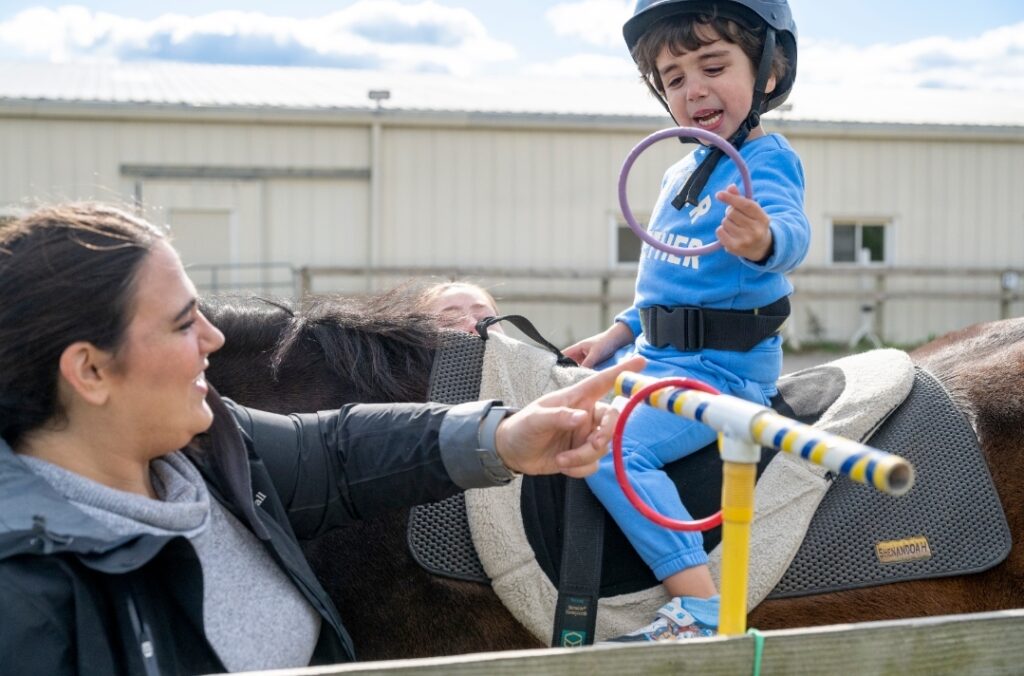
- How Hippotherapy Helps: Because the horse’s pelvic movement is symmetrical and alternating, it naturally inputs a rhythmic pattern of bilateral movement into the rider’s pelvis. Therapists build on this by having clients reach across their body (midline crossing) to grab rings, pet the horse, or switch hands while holding onto safety handles, training the brain’s left and right hemispheres to communicate efficiently.
3. Fine Motor Skills & Hand Strength
It may seem surprising that sitting on a large animal helps with delicate hand movements, but fine motor development relies entirely on proximal (shoulder and trunk) stability.
- The Challenge: Weak grip, difficulty using pencils, scissors, or buttoning shirts.
- How Hippotherapy Helps: Once the horse’s movement stabilizes the shoulder girdle and core, the therapist can introduce fine motor tasks in a highly engaging context. Clients practice grasping reins, picking up small grooming brushes, buckling leather straps, or placing rings onto targets while riding. The physical effort of holding on and adjusting grip during movement naturally builds hand, wrist, and finger strength.
4. Motor Planning and Body Awareness (Proprioception)
Motor planning is the ability to conceive, plan, and carry out a new physical task.
- The Challenge: Clumsiness, bumping into walls, or struggling to learn new physical movements.
- How Hippotherapy Helps: The warmth of the horse (which is slightly higher than human body temperature) combined with the deep pressure of the movement sends strong sensory signals to the joint receptors and muscles. This massive surge of proprioceptive feedback helps the brain map out where the body is in space. Over time, navigating stable-based obstacle courses on the horse makes planning physical movements second nature.
How Hippotherapy Transforms Daily Motor Milestones
| Motor Skill Area | Stable Activity | Real-World Success |
| Trunk Stability | Sitting upright while astride and staying at maintaining midline position and returning to midline position during turns, changing in speed, changes and slope/terrain and reaching activities. | Sitting attentively at a school desk without slouching or fatiguing. |
| Shoulder Stability | Reaching up to place rings on a hook from the saddle, grooming a horse, bathing a horse. | Improved control and endurance during handwriting and drawing. |
| Midline Crossing | Reaching across the horse’s neck during brushing, reaching for a ring or utilizing a two handed grabber to grab an item from therapist on opposite side. | Dressing independently (zippers, buttoning coats, putting on shoes). |
| Weight Shifting | Standing up in the stirrups or leaning to navigate a turn or changes in speed. | Safe climbing on playgrounds, negotiating stairs, and riding a bicycle. |
Life Skills and Executive Functioning
Conducting therapy on the farm offers a unique environment that offers a variety of opportunities for patients. Patients gain life skills through caring for/mimicking daily living tasks in the equine environment.
The Four Pillars: How Equine Movement Builds Executive Function
Recent clinical studies have shown that integrating equine movement into occupational therapy results in statistically significant improvements in attention, working memory, and self-management. It accomplishes this through four main cognitive pillars:
1. Promoting Self-Regulation and Arousal Control
For the brain to plan, memorize, or focus, it must first be in an optimal state of alertness.
- The Challenge: Many individuals struggle with hyper-arousal (overstimulated/anxious) or hypo-arousal (lethargic/daydreaming).
- The Equine Connection: The rhythmic, repetitive, and bidirectional movement of the horse provides steady vestibular (balance) and proprioceptive (deep pressure) sensory input. This natural feedback loop calms a chaotic nervous system, moving the client into a regulated, focused state where high-level thinking can actually occur.
2. Sharpening Attention and Working Memory
Working memory is the brain’s ability to hold onto information while working with it (like remembering a multi-step instruction).
- The Challenge: Staying on task and keeping instructions top-of-mind.
- The Equine Connection: While on a horse, the brain must constantly calculate balance, posture adjustments, and muscle engagement in real time. Occupational therapists layer cognitive tasks onto this movement—such as matching colored rings to targets or repeating sequences—forcing the brain to practice divided attention and hold information actively.
3. Enhancing Emotional Control and Inhibitory Control
Inhibitory control is the ability to resist impulsive reactions and choose a thoughtful response.
- The Challenge: Managing frustration or impulsive outbursts.
- The Equine Connection: Horses are highly sensitive prey animals that mirror human emotions and energy. If a client becomes loud or physically erratic, the horse responds instantly by moving or shifting. Guided by the therapist, the client receives immediate, non-judgmental biofeedback. They learn to quiet their body and regulate their breathing to keep their equine partner calm, directly training emotional control.
4. Improving Task Initiation and Sequencing
Planning and executing a multi-step task requires sequencing, organizing, and the mental drive to begin.
- The Challenge: Feeling overwhelmed by complex tasks and putting off starting them.
- The Equine Connection: The stable environment is a goldmine for motor-planning and executive habits. Therapists design activities around horse care (e.g., gathering grooming tools, sequencing the brushing process, navigating an obstacle course). This breaks down large, abstract goals into tangible, highly motivating steps.
Executive Function: Clinic vs. The Stable
Here is a quick breakdown of how traditional occupational therapy goals translate into the dynamic environment of the stable:
| Executive Function Skill | Traditional Clinic Approach | Equine-Assisted Therapy Approach |
| Self-Regulation | Using sensory swings, weighted blankets, or quiet corners. | Continuous, rhythmic 3D movement of the horse calming the central nervous system. |
| Working Memory | Memorizing visual cards or playing tabletop matching games. | Remembering a sequence of targets to ride toward while physically maintaining balance. |
| Inhibitory Control | Practice sitting still or waiting for a turn in a board game. | Controlling physical impulses and volume of voice to maintain a calm connection with a 1,000-pound animal. |
| Cognitive Flexibility | Switching between pen-and-paper tasks or tabletop rules. | Adapting to real-time changes, like the horse shifting speed or navigating a physical obstacle. |
Social Emotional Skills
Social emotional skills are challenged through interaction and communication within the team. The team includes our equine partners, a horse handler and the therapist, and sometimes a side walker. We utilize social emotional tools like books, games and horse care activities to address social-emotional skills.
1. Developing Immediate Emotional Awareness (The Living Mirror)
Many individuals, especially those with trauma, anxiety, or neurodivergence, struggle to identify what they are feeling in the moment. They might feel angry or anxious without realizing it until an outburst occurs.
- The Horse’s Role: Horses have an acute ability to sense human heart rates, muscle tension, and cortisol levels from several feet away. If a client is internally anxious but acting calm, the horse will still react to the underlying tension by stiffening its posture or pinning its ears.
- The Therapeutic Outcome: This provides instant, judgment-free biofeedback. The occupational therapist can point this out in real time (“Look at how Max’s ears shifted. What is your body telling him right now?”). The client learns to connect their internal emotional state with outward physical cues.
2. Building Non-Verbal Communication and Empathy
Over 90% of human communication is non-verbal, yet traditional social skills training often focuses heavily on spoken scripts.
- The Horse’s Role: Horses do not care about words; they communicate entirely through intent, energy, and body language. To get a horse to walk forward, stop, or stand still, a client must align their posture, facial expressions, and physical presence.
- The Therapeutic Outcome: Clients learn to practice perspective-taking (“What is the horse feeling right now? Is he tired? Is he distracted?”). This naturally translates into human interactions, helping clients become more observant of non-verbal cues in peers, teachers, and parents.
3. Fostering Confidence, Autonomy, and Efficacy
Low self-esteem and a sense of helplessness can accompany developmental or physical challenges.
- The Horse’s Role: Navigating the world on top of or alongside a 1,000-pound animal is an inherent confidence booster. When a client successfully communicates a command and the horse responds, it triggers a powerful psychological shift.
- The Therapeutic Outcome: This builds a profound sense of self-efficacy—the belief in one’s ability to succeed. The client realizes: “I am capable. I can safely guide this massive animal.” That newfound confidence directly transfers to facing challenges in the classroom or at home.
4. Overcoming Vulnerability and Building Secure Relationships
For clients who find eye contact or physical touch challenging, the therapy environment can sometimes feel high-pressure.
- The Horse’s Role: Horses offer unconditional positive regard. They do not judge a client’s academic performance, social awkwardness, or physical differences. They accept physical touch, grooming, and close proximity without the intense social demands that humans often impose.
- The Therapeutic Outcome: Being with horses allows clients to experience safe, regulating, and comforting physical attachment. This serves as a psychological bridge, teaching the brain that vulnerability is safe and paving the way for healthier relationships with people.
Social-Emotional Core Milestones Reached Through OT
| Skill Area | How It Looks in Hippotherapy | The Real-World Translation |
| Co-Regulation | Matching breathing and muscle relaxation to calm a restless horse. | Staying calm when a classroom becomes chaotic or overwhelming. |
| Frustration Tolerance | Safely handling a moment when the horse doesn’t instantly follow a cue. | Managing disappointment when a game or task doesn’t go their way. |
| Social Boundary Awareness | Learning to respect the horse’s personal space and safety zones. | Respecting peers’ personal space and understanding social boundaries. |
| Shared Focus | Working as a triad (Client, Horse, Therapist) to accomplish a goal. | Collaborating effectively on group projects or team activities. |